Nelson Mandela
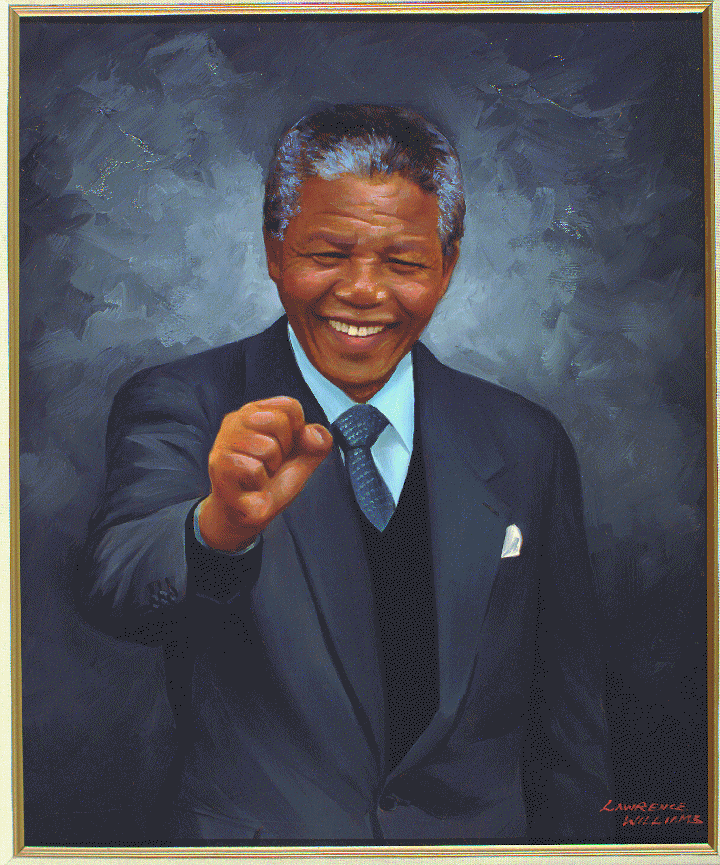 Nelson Mandela was born in 1918 in rural Umata, Transkei, South Africa. He was the son of a Tembu national chief advisor. After the death of his father, at the age of twelve, Nelson Mendela was sent to live with the chief of the Tembu nation. In his late teens, Nelson Mendela renounced his hereditary right to the chiefdom and entered college in pursuit of a law degree.
Nelson Mendela’s national name, Rolihlahia, means “one who brings trouble upon himself.” In 1940, he became a political activist and organized a student strike that led to his expulsion from the University College at Fort Hare. Soon after this experience, Nelson Mendela moved closer to the commercial capital of Johannesburg, where he worked in the gold mines and studied law by correspondence course. In 1942, he earned his law degree from the University of South Africa.
He was twenty-four when he joined the African National Congress, a group that sought to establish social and political rights for Blacks in South Africa. He and several friends established a sub-group, the Congress Youth League. Nelson Mendela challenged the racist political system of apartheid, in which Black Africans were legally discriminated against in every area of civil and human rights.
Through their relentless stamina, keen intelligence, and an undying commitment to freedom, Nelson Mandela and the ANC coordinated labor strikes and campaigns during the 1940s, ‘50s and ‘60s. Their efforts were met with cruel resistance, torture, and the shedding of Black blood from the White-dominated South African government. Nelson Mandela and other ANC members were arrested and charged with treason. In 1964, Nelson Mandela was sentenced to life in prison. He was sent to Robben Island, a prison seven miles off the coast of Cape Town. There, Nelson Mandela endured years of hard labor that inevitably deteriorated his health.
In his absence, the vitality and momentum of the ANC and the anti- apartheid still reverberated with force and strength. By the late 1980s, social conditions in South Africa had become extremely hostile and violent between young Black South Africans and government forces. The international community led by Black Americans expressed more intolerance for the apartheid system.
Finally in 1990, after twenty-seven years of imprisonment, the South African government released the most important political prisoner of the late twentieth century, Nelson Mandela. In 1995, in the first free elections in the history of South Africa, Nelson Mandela became the first Black African president.