Ahmos
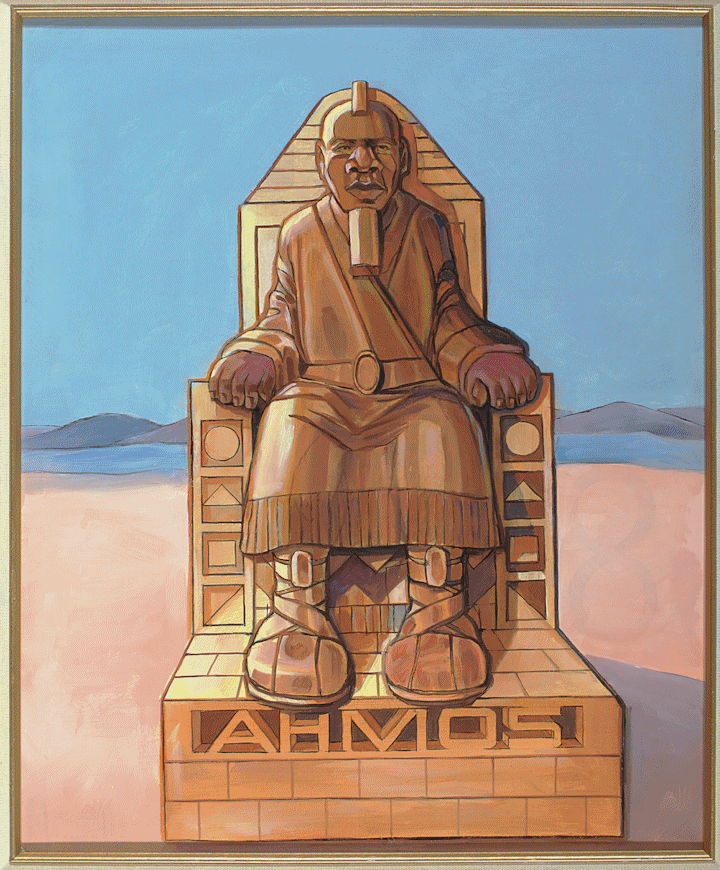 One of the greatest mathematicians of all times is the African scribe, Ahmos, who lived approximately 3,700 years ago. The World Book Encyclopedia credits him with creating algebra with these words, “. . . the first definite traces of algebra were found in the writings of the Egyptian, Ahmos, who lived about 1700 B.C. or earlier. Much later the Greeks added their contributions to its development.”
Ahmos wrote a mathematical textbook for children consisting of more than eighty mathematical problems and their solutions. This ancient papyrus was discovered in the tomb of Ahmos in the mid-nineteenth century. “Many exercises in the book show us that Africans, two thousand years before the Greeks, studied the mathematics of the pyramid and of the cone, the tangent, the sine, the cosine, and the cotangent,” according to Cheikh Anta Diop. The problems in the Ahmos Papyrus addressed the surface of the sphere, the square root, and many other mathematical concepts.
It also addressed the calculations to determine the lengths of the sides of a right triangle based on the formula that the hypotenuse squared is equal to the sum of the squares of the other two sides. An example showing how Europeans have robbed the world of the knowledge of the contributions of African people is this note: A Greek, named Pythagoras, born 1,100 hundred years after Ahmos, ca. 580 B.C., came to Egypt as a student and learned the Ahmos method of calculating the length of the sides of a right triangle. He went back to Greece and claimed this methodology for himself, calling it the Pythagorean Theorem, which we in error call it today instead of its correct name, the Ahmos Theorem. Problem 79 in the Ahmos Papyrus deals with a geometric progression of a ratio of seven called, “The inventory of goods contained in a house.”
Most people will recognize the similarity with the Mother Goose Nursery Rhyme, “As I Was Going To St. Ives” written more than two thousand years afterwards. While this papyrus is the Ahmos Papyrus, it is known to the Euro-centric world as the Rhind Mathematical Papyrus. This is because after it was found in the tomb of the scribe, Ahmos, it was purchased by the Scotsman Alexander Rhind who brought it to London and elected to ignore its author and named it the Rhind Mathematical Papyrus. Today it can be seen in the British Museum.